
Using AI to Transform Sewer Network Management
1. THE BACKGROUND
Serving over 2.2 million households, Yorkshire Water’s 53,000km sewer network spans across West Yorkshire, South Yorkshire, North Yorkshire, the East Riding of Yorkshire, and part of Derbyshire.
StormHarvester and Yorkshire Water began working together in 2024 after they recognised that their existing reactive approach to alarms and incident management was no longer sustainable. The utility needed a solution that could keep pace with new and future requirements, without adding complexity to an already evolving landscape.
Previously, alarm noise placed considerable strain on operational teams and limited their capacity to focus on proactive work, and it was clear that a smarter way of working was needed. By embedding StormHarvester, Yorkshire Water aimed to shift operations from a predominantly reactive model to one that was proactive, and insight led.
2. THE APPROACH
Yorkshire Water are using StormHarvester across their network and seeing benefits in reducing storm overflows. This case study will focus on in-depth application and benefits relating to three modules: blockage detection, pump station alerting and customer sewer alarm (CSA) alerting. They required a solution that would help:
- Detect developing blockages, failures and bursts before they escalate into pollution incidents.
- Identify hotspot locations in the network that repeatedly experience blockages, pump failures, and burst rising mains.
- Prioritise high-risk areas where the consequence of a blockage or overflow is greatest.
- Transition from a reactive operational model to a scalable, proactive approach to network risk management.
“Since launching our Operational Intelligence function at Yorkshire Water in December 2024, we have realised significant benefits, enabling us to operate as a more proactive business. Our strong working relationship with StormHarvester has been instrumental in this success, supporting the rapid growth of our Operational Intelligence team to its current state in just 18 months.
Across departments and at all levels, teams find the data easy to understand and navigate. This accessibility has been particularly valuable for field teams across the region, who regularly use the platform to support their on-site investigations.”
Andy Newell, Operational Intelligence Technical Team Leader
BLOCKAGE DETECTION
Key stats:
- 691 blockages removed
- 80% alert hit rate
Blockages are one of the most persistent and costly challenges that utilities face. Often detected after damage has occurred, they represent a significant operational burden and are a leading cause of sewer flooding and pollution incidents.
Over 17,000 Sewer Level Monitors (SLMs) have been installed across Yorkshire Water’s sewer network. StormHarvester continuously monitors the sewer network, combining live level data, hyperlocal rainfall, and machine learning to identify anomalies in sensor readings. High risk areas were identified across the network, based on their proximity to watercourses and the gradient of land around the manhole.
Early identification of anomalies has:
- Enabled operations teams to prioritise alerts to investigate issues before they escalate.
- Resulted in 691 blockages successfully cleared from the sewer network. Based on the asset type and the placement of the SLMs, if these blockages hadn’t been removed, it is likely they would have resulted in a pollution incident into nearby watercourses.
4. THE OUTCOME
The blockage detection trial delivered results that far exceeded what South West Water's existing monitoring had been able to provide. The benefits were clear and significant, giving the confidence needed to commit to a full deployment across all circa 1,400 Combined Sewer Overflows. Scaling from the initial 300 trial sites by onboarding an additional 300 sites each month until complete coverage was achieved.
StormHarvester achieved a reactive alert noise reduction of 93%. Utilising our proactive alerts, 363 issues were successfully identified, while a further 395 proactive investigations were carried out.
5. EXAMPLE 1
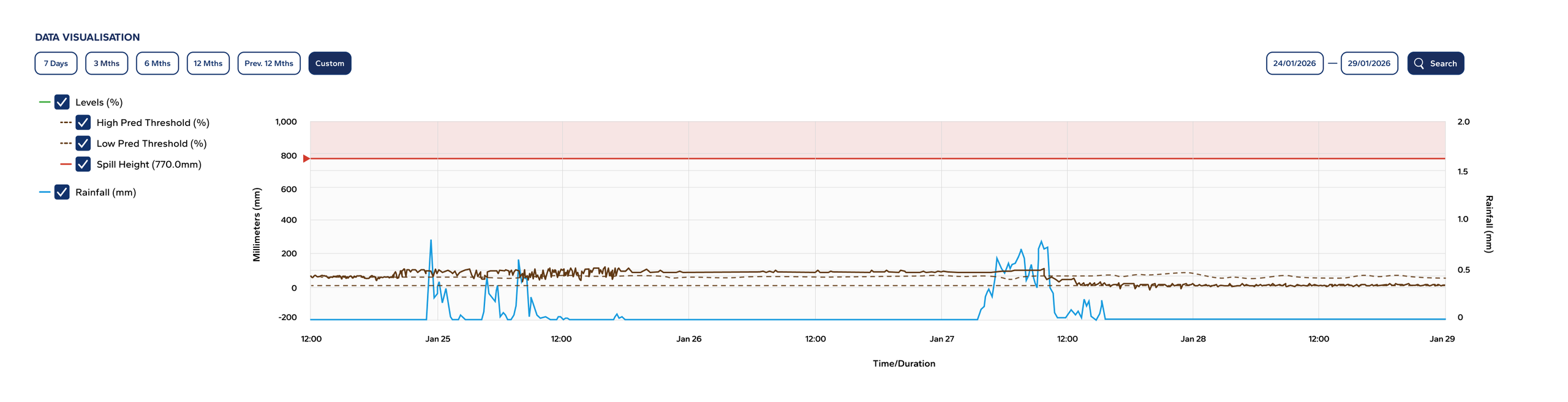
24/01 – Sewer levels remain within the dynamic thresholds.
25/01 – Sewer levels breach dynamic thresholds, triggering StormHarvester alert.
27/01 – Crew attends site and finds a large kerb stone causing the blockage. Kerb stone is removed, and levels return within dynamic thresholds.
6. EXAMPLE 2
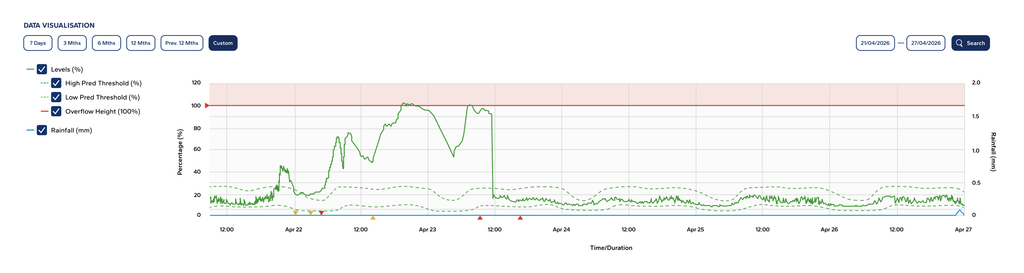
- 21/04 – Sewer levels remain within dynamic thresholds.
- 22/04 – Sewer levels breach dynamic thresholds, triggering StormHarvester alert.
- 23/04 – Crew attends site and finds a large amount of silt. Blockage is cleared by jetting.
- 24/04 – Sewer levels return within dynamic thresholds.
7. PUMP STATION ALERTING
Key stats:
- 85.6% positive interventions
- 209 blockages removed
- 449 follow up jobs created
StormHarvester’s Pump Station Alerting was deployed to provide Yorkshire Water with AI-driven insights into pump performance. The system analyses pump start/stop, wet well level, and performance trends and corelates them with live weather conditions, to detect anomalies before failure occurs.
Over 4,400 sensors have been implemented to Pump Stations across Yorkshire Water's network, leading to an 85.6% positive intervention rate on issues detected by the StormHarvester platform. 1674 alerts have been sent by StormHarvester, helping Yorkshire Water’s operational teams prioritise jobs across their network.
Example 1
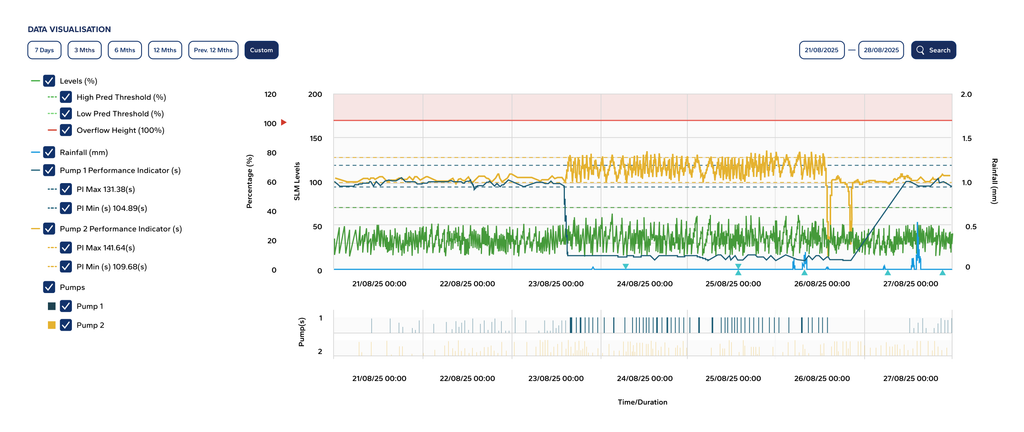
23/08 – Pump 1 falls below the threshold and run time shorter alert is sent. Wet well level is increasing despite pump being turned on.
26/08 – Crew attends pumping station and fix a collapsed bearing in the pump.
27/08 – Pump 1 returns within normal operating thresholds
8. CSA ALERTING
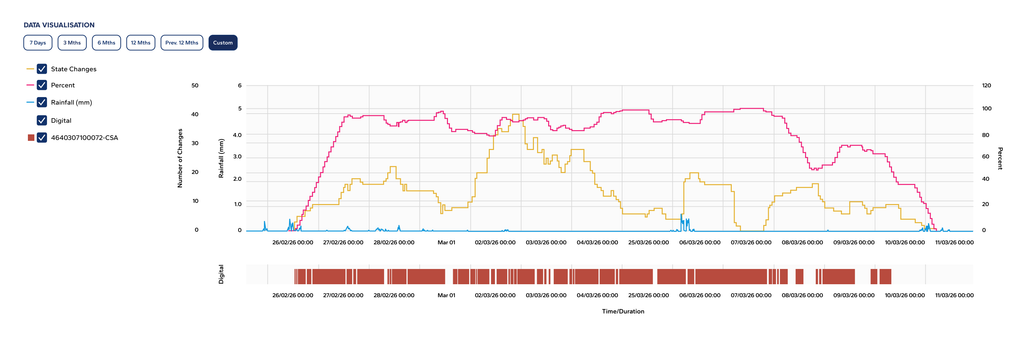
Customer Sewer Alarms (CSAs) are installed across Yorkshire Water’s network to help detect blockages and reduce the risk of flooding at customer property level. StormHarvester’s CSA Alerting uses data from digital level monitors, including manhole and gully sensors.
If levels are elevated above a configured percentage threshold for a prolonged period, StormHarvester triggers an alert. This allows Yorkshire Water crews to investigate potential blockages or issues before sewage back up into homes, while significantly reducing false alarms caused by everyday water use.
In recent years, over 55,000 sewer alarms have been installed across the Yorkshire region. The development of the CSA Alerting module represents a true innovative partnership. Yorkshire Water provided the real-world data and operational insights needed to build and test this monitoring capability and will continue to support the refinement of the module.
What began as a collaborative innovation piece is now scaling into a network-wide expansion that will see 65,000 more monitors installed by 2030.
EXAMPLE
26/02 - Levels begin to rise in customer gully and remain consistently high for an increased period, activating the customer sewer alarm.
04/03 - A StormHarvester alert is triggered, and a work order is raised on 06/03 to investigate the abnormal levels. Crew find blockage in the gully and remove it, using jetting.
11/03 - Levels return to normal after intervention and customer sewer alarm stops alarming.
9. CONCLUSION
StormHarvester’s AI-powered monitoring solutions have delivered measurable operational, environmental and financial impact for Yorkshire Water across both their pump station and sewer network infrastructure. Year to date, over 3,700 jobs have been raised from alerts sent by StormHarvester, with a 99.2% positive intervention rate on triaged alerts. Over 900 blockages have been successfully removed across Yorkshire Water’s network.
StormHarvester has supported Yorkshire Water to:
- Move toward a proactive approach to their wastewater network management
- Detect issues before they escalate into more serious incidents
- Reduce internal flooding into customer’s homes
10. FUTURE PLANS
Yorkshire Water are continuing to implement new sensors across their wastewater network, as well as extending the scope of the relationship including detection of inflow and infiltration and rising main alerting. They are actively looking to expand the use of technology to monitor their network and will have over 150,000 monitors installed across the network by the end of 2030.