Pump Station Alerting: A Proactive Approach to Pump Performance for Southern Water
1. THE BACKGROUND
Southern Water previously relied on static Hi-Hi alarms to monitor its pump stations. During periods of heavy rainfall, these alarms would trigger, offering little clarity on which sites genuinely required attention. As a result, many alerts were routinely “paused”, and critical issues often went undetected until pumps had already failed. This led to reactive callouts, often out of hours, and significant operational disruption. Operations teams were often overwhelmed and felt unable to tell which alerts required responses.
2. THE SOLUTION
StormHarvester’s Pump Station Alerting was deployed to provide Southern Water with real-time, AI-drive insights into pump performance. The system analyses pump start/stops, wet well levels, and performance trends - correlating them with live weather conditions to detect anomalies before failure occurs.
Descriptive alerts provide actionable insights to issues occurring at pump stations:
- Run time longer
- Run time shorter
- Wet well low
- Pumps long off
- Pump possibly ineffective
- Level high with no pumps active
Key benefits:
- Optimise Assets - Maintaining a consistent performance reduces energy
- Target Callouts - Send crews exactly where they’re needed, cutting response times and eliminating guesswork.
- Safeguard Environment - Early detection prevents pollution incidents and helps to maintain regulatory compliance and maintenance costs.
3. THE DEPLOYMENT
The rollout began in Kent, followed by Hampshire and Sussex, with thousands of pump stations onboarded weekly.
- Sites became alert-active within 2 weeks from instructions to proceed.
- Sites with metadata amendments followed shortly afterwards.
- The StormHarvester team held daily touchpoint meetings for the first 4 weeks to embed the technology effectively into the utility operations team, before moving to weekly check-ins.
4. THE OUTCOME
The implementation enabled Southern Water to transition from reactive to proactive operations. Alerts were more trusted, more actionable, and often resolved during normal working hours rather than out of hours as the machine learning based dynamic alerts detected early signs of impending pump station failure taking account of ambient weather conditions.
Faults were identified early and rectified quickly, including:
- Pump blocked/restricted
- Worn/incorrect impellor or wear plate
- Pump not seated correctly
- Wet well build-up
- Recirculation due to NRV passing
- Air valves functioning incorrectly
- Pump control philosophy amended/changed
- Pump tripped fuse
- Level control fault
- Snoring pumps due to low wet well levels
- Burst rising /pumped mains
Operators gained confidence in the system and began using the pump station visualisation tools for real-time situational awareness across the network. The alert hit rate increased to 88% following the resolution of data issues and adjustment of thresholds.
“We brought in StormHarvester to replace our internal platform, which was struggling with an overwhelming amount of waste data that was difficult to translate into actionable tasks for our sewerage pumping stations. By leveraging StormHarvester’s advanced machine learning and artificial intelligence capabilities, we have been able to significantly reduce this waste, enabling our teams to focus on meaningful, high-impact jobs. This shift has not only enhanced the quality and relevance of the insights we receive but also improved operational efficiency across the board. In addition to delivering clear and actionable insights, StormHarvester has greatly enhanced the overall user experience. Their intuitive interface and streamlined workflows have empowered our staff to make faster, better-informed decisions, ultimately driving greater value and effectiveness in managing our sewerage infrastructure.” - Richard Martin, Head of Operation Control Centre - Waste
EXAMPLE 1
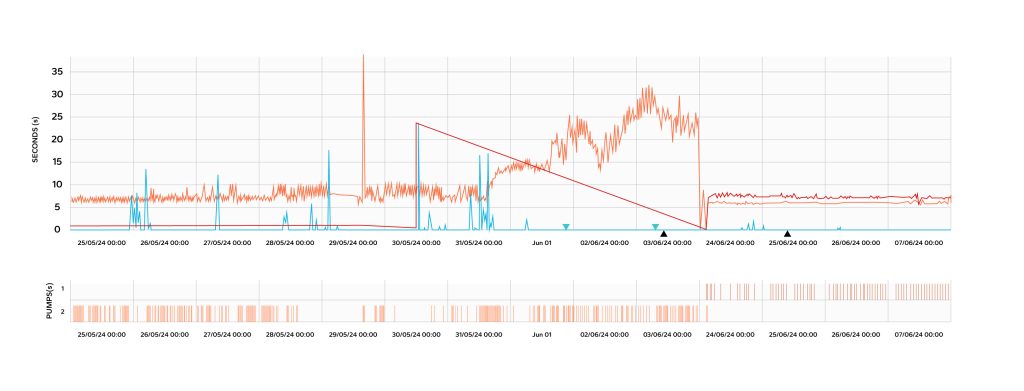
1 June: Pump Performance Indicator for pump 2 rising and pump taking longer to drain down the well. Alert was sent and the operations team went to investigate.
3 June: Pump was lifted to find the Impellor damaged, and a soft blockage was found. The damage to the Impellor was caused by brick and rag.
4 June: The Pump performance Indicator can be seen to return to normal.
EXAMPLE 2
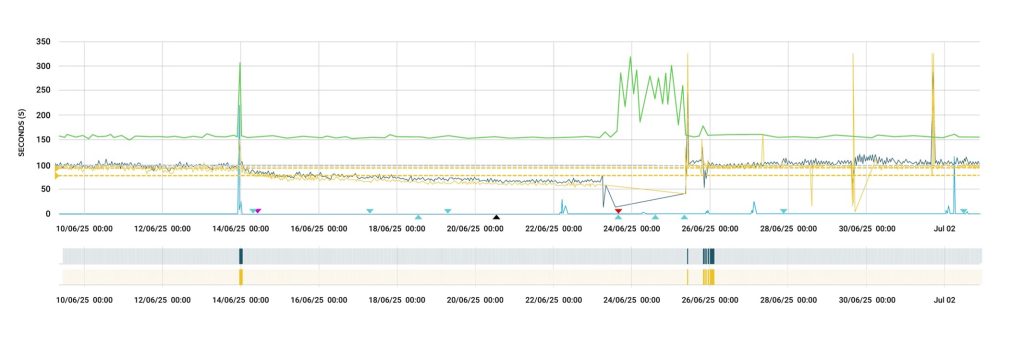
14 June: Pump Performance Indicator for both pumps drop at the same time and a burst alert is raised.
17 June: Contractor attended site and found no issues.
20 June: WO raised to investigate possible burst rising main.
21 June: Proactive tankering commenced. Pump Performance Indicator for both pumps drop at the same time and a burst alert is raised.
23 June: Burst rising main confirmed onsite. Burst confirmed to be 190m away from the site.
26 June: Burst repaired and performance restored.