

Inflow and Infiltration – Using AI to determine the underlying causes of sewer overflows
1. CHALLENGE
Wastewater utilities are continuously exploring ways of enhancing protection to the environment by reducing their number of sewer overflows into watercourses.
For Southern Water, this involved an analysis of what was causing spills by looking at Event Duration Monitor (EDM) spill data. Wastewater utility companies want to determine how their network performs at each overflow location.
The key questions to answer were if overflows were:
- Driven by exceptional rainfall as intended.
- Driven by inflow and infiltration into the network.
- Due to operational issues (e.g. pump failure).
Working with Southern Water and Stantec, we used machine learning and hyperlocal rainfall to characterise overflows and their determining factors. We found that:
- A relatively small number of sites experienced a disproportionate number of overflows
- In many of these cases, inflow and infiltration was identified as an underlying cause.
Inflow and Infiltration cause significant problems for wastewater assets and their operators. When sea water, river water, and the infiltration of groundwater enters the wastewater network, it can cause problems such as:
- Increased overflows
- Damage to sewer network infrastructure.
- Reduced network capacity for incoming sewage.
- Imbalance of microbiome in the treatment works and the need to treat larger volumes of wastewater than necessary (leading to increased costs and carbon footprint).
2. OUR APPROACH
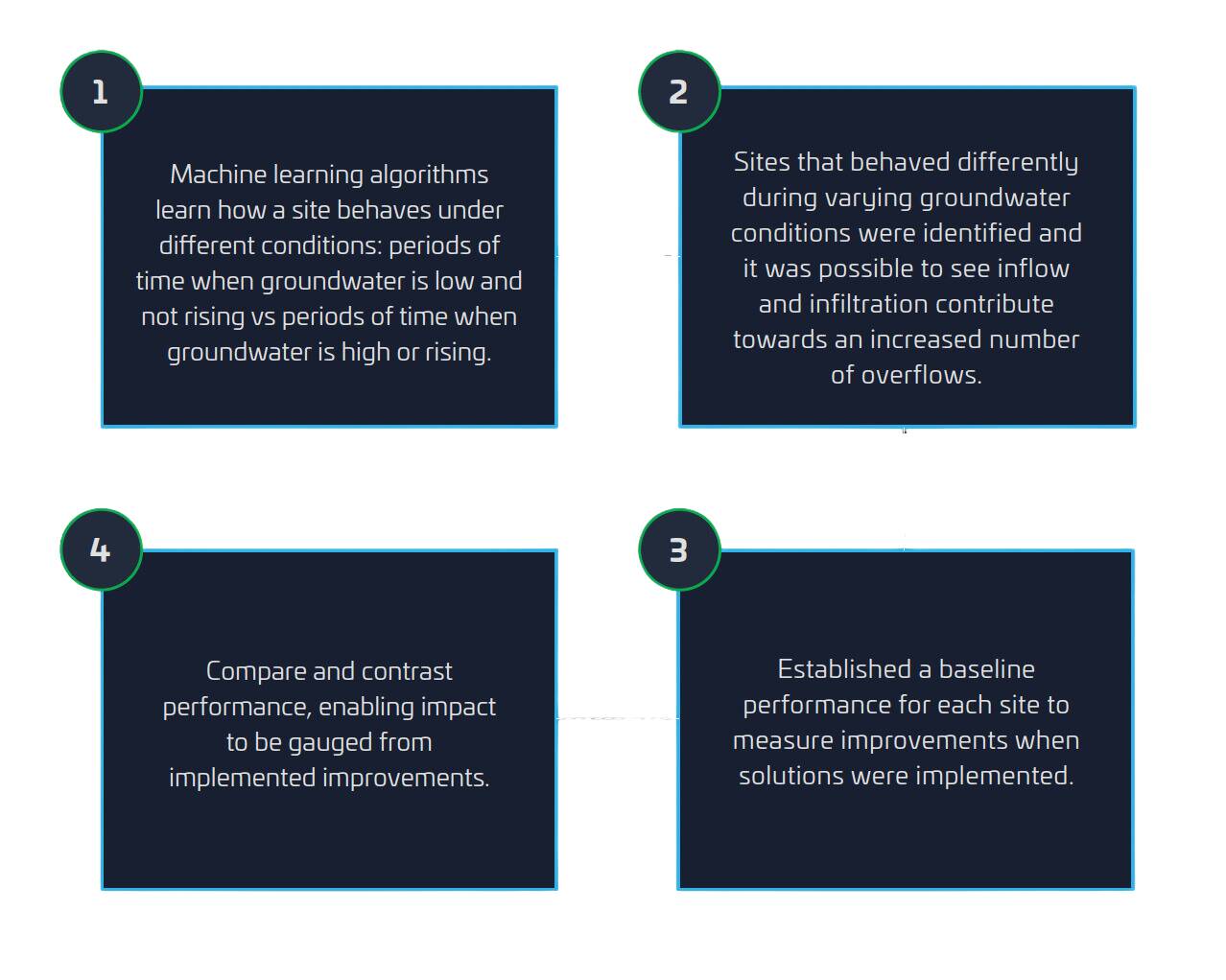
Each site is considered separately to allow for models to learn and predict site-specific patterns and behaviours. This approach gives more accurate predictions of how sites will perform leading to a higher confidence in the comparison of predicted vs actual behaviour after improvements have been implemented.
Once the machine learning algorithms had been trained for each site, we used the Network Visualisation module to identify locations where I&I is present in context at network scale.
3. THE RESULTS
Using the trained machine learning algorithms for all wastewater network sensors in Southern Water, we discovered that a large number of overflows came from a small number of sites, and 25% of overflows occurred at sites with I&I present.
The correlation to rainfall was not directly apparent for I&I and further analysis found a correlation existed with levels and rates of change of groundwater sewer levels. If a site is reactive to rainfall, you would expect the site to not overflow with lower quantities of rainfall and begin to spill with larger quantities.
At sites with I&I, the site doesn’t overflow during the summer months with larger rainfall events but overflows continuously from January to April with considerably smaller rainfall events.
4. NEXT STEPS
This insight has proven to be invaluable to Southern Water and has led to a more targeted WINEP – Water Industry National Environmental Plan.
This project has also allowed Southern Water to consider new solutions to reduce overflows.
Traditional solutions have had a focus on increasing network capacity, however now, there is the possibility to implement more sustainable and affordable solutions to address the source by limiting the I&I paths into the network. E.g. lining sections of the sewer network or locating and removing misconnections from local springs and streams.