

A long term perspective: From success in the marketplace to full EDM rollout
Project Description
1. BACKGROUND.
Wessex Water provides water and sewerage services to 2.8million people in the South West of England with 35,000km of sewers, clearing approximately 13,000 blockages a year at a cost of £5m annually.
In May 2020, amongst strong international competition, StormHarvester became a successful finalist in a 3 month smart sewer trial with Wessex Water in the city of Bath wastewater catchment.
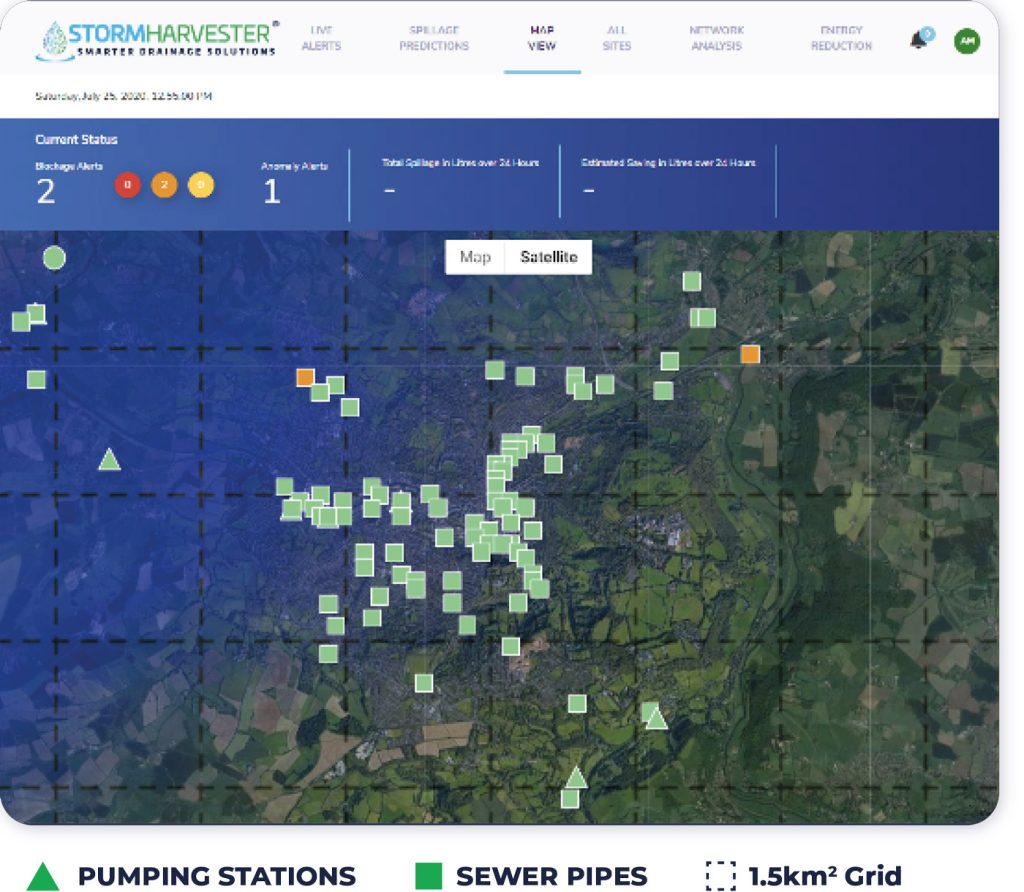
Bath consists of approx. 3,500km of sewers representing c.10% of the Wessex Water total. Across this network there were 98 sensored assets, 89 of these were at combined sewer overflow (CSO) locations and the remainder at pumping (lift) stations.
“One of the biggest problems we have serving our customers is not knowing where and when blockages will occur, or are likely to occur, in the wastewater network.”
Jody Knight, Asset Technology Manager Wessex Water
2. THE CHALLENGE.
Wessex Water’s goal was to use latest technologies to gain additional insights from their existing network of wastewater sensors. Specifically, the company wanted to test the ability of AI (machine learning) to:
- Accurately Detect Early Blockage Formations: If left unchecked, early blockage formations can lead to service failures i.e. pollution or flooding events. However, if spotted early enough, blockage formations can be cleared and therefore costly service failures avoided.
- Create Smarter (Control Room) Alarms: During wet weather it is difficult to differentiate expected high sewer levels caused by heavy rainfall volumes from those higher than usual levels arising from restrictions in the network i.e. by partial or total blockages.
If AI could differentiate between these different events, then both an improvement in alarm quality along with alarm rationalisation could be possible.
During Spring 2020, Wessex Water ran a challenge with 16 entrants to demonstrate the value of applying AI (machine-learning) to it’s wastewater network with the following objectives:
- Predicting early blockage formations before they become service failures (i.e. pollution or flooding incidents)
- Viability of condition based maintenance
- Ability to differentiate genuine control room alarms from those triggered simply because of high volumes of rainfall
StormHarvester became a finalist and ran an initial 3-month proof of concept over Spring/Summer 2020 against these objectives.
3. THE SOLUTION.
Across the Summer of 2020 StormHarvester deployed its Intelligent Sewer Suite product to provide real-time level predictions and alerts on early blockage formations for the sewer network of the city of Bath. These alerts were used to identify potential non-compliant out-of-sewer pollution events before they occurred so that maintenance crews could proactively remedy issues before they resulted in service failures (i.e. pollution or flooding incidents).
The Intelligent Sewer Suite’s proprietary AI (machine learning) algorithms and predictive analysis tools were used on both CSO and pumping station sensor data with corresponding hyperlocal rainfall forecast data, to predict network levels and detect potential blockage formations in real-time. Only existing sensors were used for this purpose and no new sensor installations were required.
Outline StormHarvester AI and Predictive Analysis Process
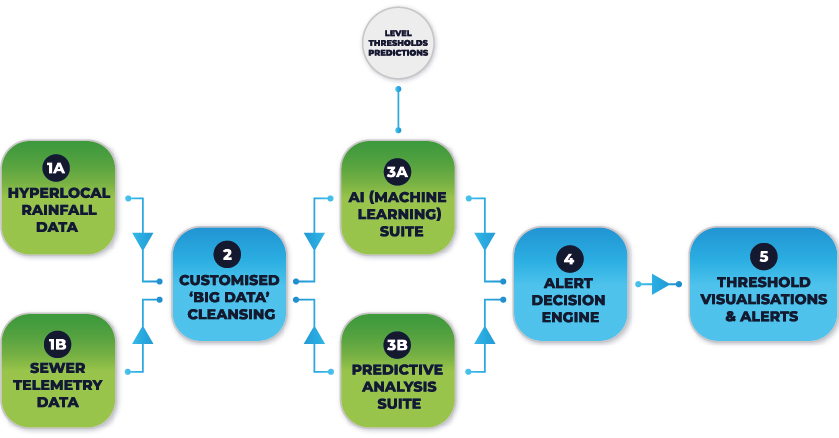
The StormHarvester system took only 3 weeks to set-up before it started developing usable results. The process included the extraction of historic sewer level data and historic rainfall levels in a 1.5km squared grid for each of the 98 assets, and the undertaking of tens of millions of iterative machine learning calculations in order to ‘learn’ sewer asset behaviour in both dry and wet weather periods.
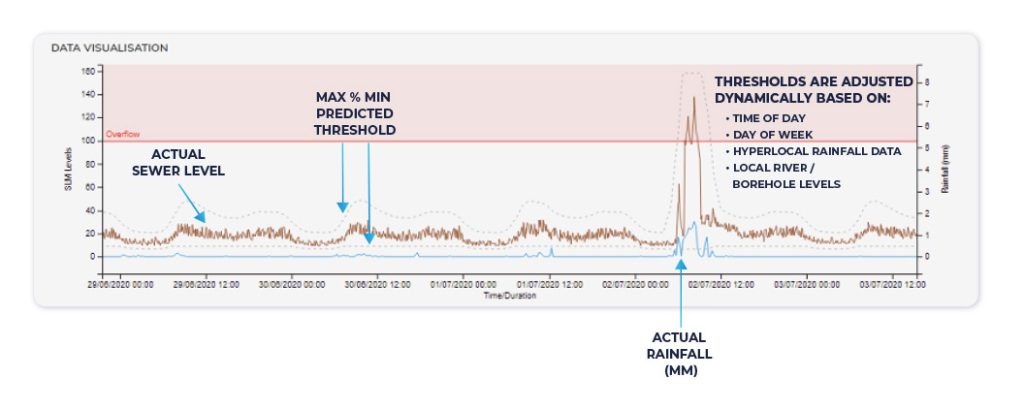
The safe operating window or thresholds are predicted based on a number of factors including time of day, day of week, hyperlocal rainfall, local river/borehole levels, etc. These dynamic thresholds are predicted for 6 hours into the future and are updated every 15 minutes on an asset level. This is one of the keys to such accurate forecasting.
The solution did not require or utilise any hydraulic models which was key to its quick set up and accuracy.
Bath Catchment Monitors
“The Stormharvester system used machine learning to set safe operating windows or thresholds for each asset. Each time these had a significant breach, we received alerts, which in turn were passed to the Operations team so that they could respond.”
Edmund Willatts, Asset Reliability Engineer Wessex Water
Predictive Sewer Levels Threshold for Each Asset Continually Adjusted in Real-time
“The Stormharvester system used machine learning to set safe operating windows or thresholds for each asset. Each time these had a significant breach, we received alerts, which in turn were passed to the Operations team so that they could respond.”
Edmund Willatts, Asset Reliability Engineer Wessex Water
4. THE RESULTS.
In 3 months, StormHarvester’s Intelligent Sewer Suite detected over 60 early blockage formations in real time, at least 2 of which Wessex Water told us were likely to have caused significant pollution incidents (CAT 3 or worse) if it was not for these alerts. Over 60 telemetry and sensor faults were also detected in real time.
Wessex Water considered the alerts provided by StormHarvester a major improvement on the status quo where operational staff were regularly overwhelmed by the large number of high-level and overflow alarms occurring in the control room during periods of heavy rainfall.
Based on the value brought by the StormHarvester alerts Wessex Water decided to keep the alerting system running on the Bath catchment after the initial POC.
“During the trial, StormHarvester were able to identify sewer blockages very early on and we were therefore able to get the Operation teams to proactively intervene. This significantly increased our chances of making it quicker and easier to spot spillages.”
Jody Knight, Asset Technology Manager Wessex Water
The Wessex Water results proved the value of AI to accurately predict blockage and anomalies, enable a shift towards condition based maintenance and rationalise control room alarms.
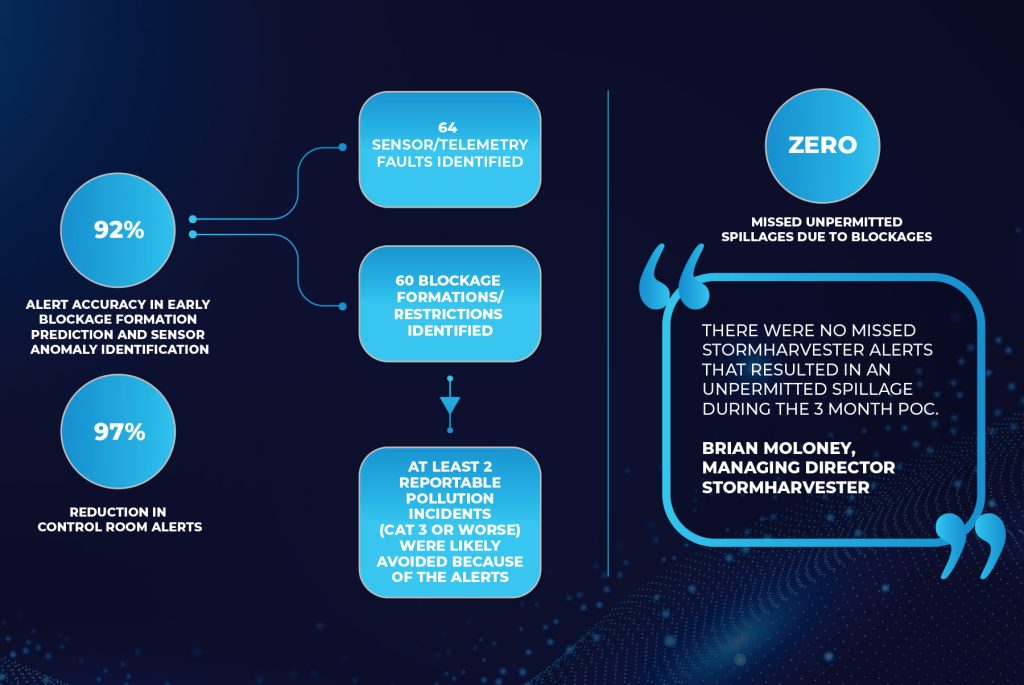
The Wessex pilot revealed the following:
1. High Blockage Prediction Accuracy:
A high degree of early blockage alert accuracy with 92% of alerts StormHarvester provided were relevant and required.
During the course of the trial there was less than 10% false positives and most importantly not a single blockage resulting in a pollution incident was missed.
2. Long-range Blockage Prediction Capability:
Early blockage formations were identified up to 8 weeks before they would have resulted in service failures.
3. Condition Based Maintenance is a Realistic Goal:
The 3 month trial enabled a shift towards a condition based maintenance approach.
4. Successful Control Room Alarm Rationalisation:
4500 alarms were generated by Wessex Water during the pilot period. However, if the StormHarvester solution had been utilised instead of the incumbent rules-based alarms system, a 97% reduction in control room alerts would have been achieved.
StormHarvester alerted only 138 times (a manageable volume) meaning Wessex Water operational and maintenance crews could respond to these ‘smart alarms’ even during periods of heavy rainfall.